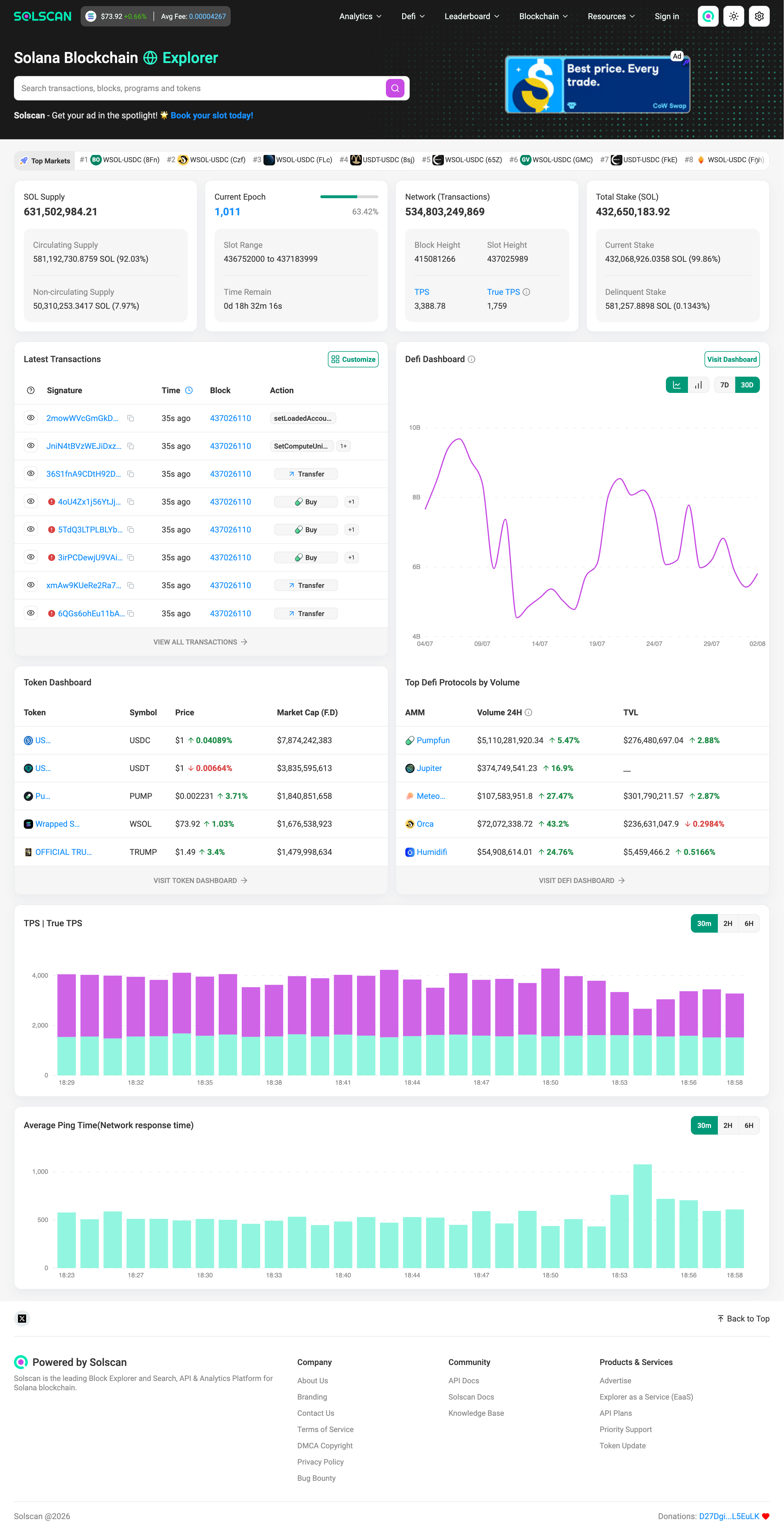
As blockchain technology continues to evolve, users need reliable tools to explore and verify on-chain activity. For the Solana ecosystem, Solscan is one of the most widely used blockchain explorers, providing an intuitive interface to view transactions, wallet addresses, tokens, NFTs, staking information, and smart contract activity.
Whether you're a cryptocurrency investor, developer, validator, or NFT collector, Solscan makes it easy to navigate the Solana blockchain and access real-time blockchain data.
What Is Solscan?
Solscan is a blockchain explorer built for the Solana network. It enables users to search and analyze publicly available blockchain information by entering a wallet address, transaction signature, block number, token mint address, or program ID.
Unlike a cryptocurrency wallet, Solscan does not store digital assets or private keys. Instead, it serves as a read-only platform that organizes complex blockchain data into an easy-to-understand format.
How Solscan Works
Every transaction executed on the Solana blockchain is permanently recorded on the distributed ledger. Solscan retrieves this public data and presents it through a user-friendly dashboard.
Users can search for:
Wallet addresses
Transaction signatures
Token information
NFT collections
Validator details
Blocks
Programs (smart contracts)
This allows anyone to independently verify blockchain activity without relying on centralized intermediaries.
Key Features of Solscan
1. Transaction Explorer
One of Solscan's primary functions is tracking Solana transactions.
By entering a transaction signature, users can view:
Transaction status
Sender and recipient addresses
Tokens transferred
Transaction fees
Block information
Timestamp
Program interactions
This feature helps users confirm whether a transaction has been successfully completed.
2. Wallet Address Lookup
Solscan allows users to inspect any public Solana wallet.
Wallet pages typically display:
SOL balance
SPL token holdings
NFT collections
Transaction history
Staking information
Token transfers
Because Solana is a public blockchain, anyone can access this information using a wallet's public address.
3. Token Explorer
Users can research Solana-based tokens using Solscan.
Token pages include details such as:
Token name and symbol
Mint address
Total supply
Number of holders
Recent transfers
Market-related information (when available)
This information helps investors evaluate tokens before interacting with them.
4. NFT Explorer
Solscan supports Solana's thriving NFT ecosystem by providing information about:
NFT collections
Individual NFT metadata
Ownership history
Mint transactions
Transfer records
Collectors can verify ownership and review an NFT's transaction history directly from the blockchain.
5. Validator and Staking Information
Solana uses a Proof of Stake (PoS) consensus mechanism. Solscan provides insights into validator performance and staking activity.
Users can view:
Validator rankings
Voting statistics
Stake amounts
Commission rates
Network participation
This information is useful for users deciding where to delegate their SOL tokens.
6. Block Explorer
Solscan enables users to inspect recently produced blocks, including:
Block height
Block time
Number of transactions
Validator responsible for producing the block
Block rewards
Network statistics
This provides transparency into Solana's network operations.
Benefits of Using Solscan
Solscan offers several advantages:
Real-time blockchain data
Transparent transaction verification
Easy wallet tracking
NFT ownership verification
Token research tools
Validator performance monitoring
User-friendly interface for beginners and experienced users alike
Its organized dashboard simplifies access to complex blockchain information.
Common Use Cases
People use Solscan for many purposes, including:
Confirming SOL transactions
Tracking wallet activity
Researching SPL tokens
Verifying NFT ownership
Monitoring staking rewards
Exploring decentralized finance (DeFi) transactions
Auditing blockchain activity
Investigating failed transactions
Is Solscan Safe?
Solscan is generally considered safe because it only displays publicly available blockchain data. It does not require users to share private keys or recovery phrases to search the blockchain.
Users should always verify they are using the official Solscan website and never disclose sensitive wallet credentials to any platform or individual.
Limitations of Solscan
Although Solscan is a powerful blockchain explorer, it has some limitations:
It cannot reverse completed blockchain transactions.
It cannot recover lost cryptocurrency.
It does not function as a cryptocurrency wallet.
It only displays publicly available blockchain data.
It cannot prevent users from sending funds to incorrect wallet addresses.
Understanding these limitations helps users use the platform effectively and securely.
Why Solscan Matters
Transparency is one of blockchain technology's core principles, and Solscan makes Solana's public ledger accessible to everyone. It allows users to independently verify transactions, inspect wallets, analyze token activity, and monitor validator performance without relying on third parties.
For developers, Solscan provides valuable debugging and analytics tools. For investors, it offers insights into token movements and wallet activity. For NFT enthusiasts, it enables easy verification of ownership and transaction history.
Conclusion
Solscan has become an essential tool for anyone interacting with the Solana ecosystem. By converting complex blockchain data into a clear and searchable interface, it helps users understand network activity, verify transactions, and research tokens, NFTs, and validators with confidence.
As the Solana ecosystem continues to expand across decentralized finance, gaming, NFTs, and Web3 applications, Solscan will remain an indispensable resource for exploring and understanding the blockchain.

Website Software